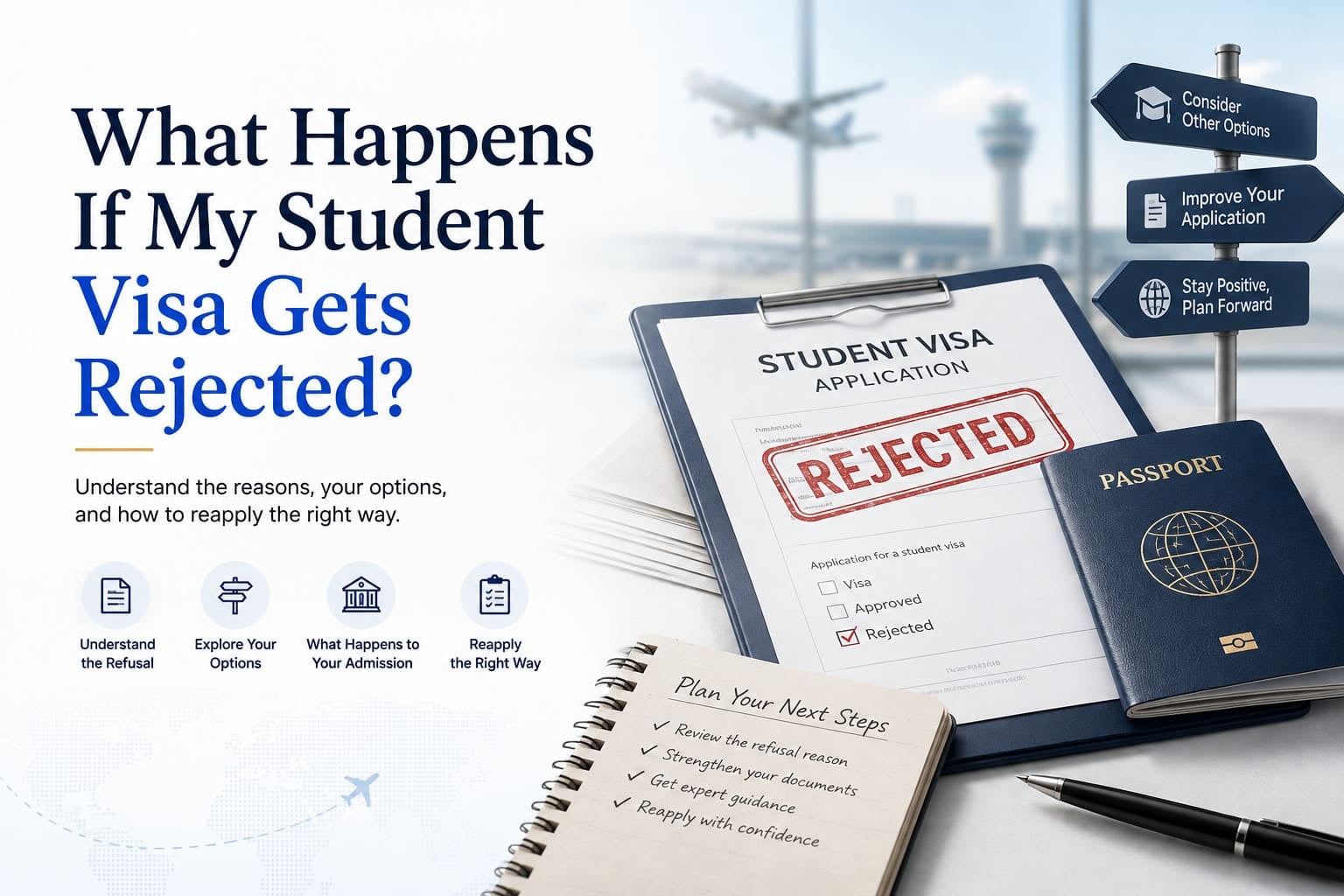
What Happens If My Student Visa Gets Rejected?
Getting a student visa refusal after receiving an offer from a university can feel like the entire study abroad plan has collapsed. It has not necessarily collapsed.
A visa refusal means the immigration authority has decided that you did not meet the requirements for that particular visa application. It does not automatically mean that you cannot study abroad, that the university will cancel your admission, or that you can never apply for the same country again.
What matters next is why the visa was refused and what you do with that information.
The correct response to a refusal is not to immediately submit another application with the same documents. In fact, countries such as Canada explicitly warn applicants that simply applying again with the same information will not change a refused study permit decision.
This guide explains what happens after a student visa rejection, what your options are, whether you can reapply, what happens to your university admission and tuition deposit, and how to approach a second application.
First: A Visa Refusal Is Not the Same as a University Rejection
This distinction is important.
There are usually two separate decisions in the study abroad process:
The university decides whether to admit you.
The immigration authority decides whether to issue you a visa.
You can therefore have:
University admission → Visa refusal
Your university may still consider you an admitted student even though immigration has refused your visa.
What happens to your admission after that depends on the university's policies and your intake date. Some universities may allow you to defer your admission to the next intake. Others may require you to request a new confirmation document.
You should contact your university's international admissions office as soon as you receive the refusal.
Do not assume that your admission automatically disappears.
Why Do Student Visas Get Rejected?
There is no single reason for student visa refusals. Immigration officers generally assess whether the applicant meets the legal requirements of the visa and whether the evidence submitted supports the application.
Some of the most common problems include the following.
1. Insufficient or Unclear Financial Evidence
You may have enough money but fail to demonstrate it convincingly.
For example:
unexplained large deposits
inconsistent bank statements
insufficient funds
unclear source of funds
financial documents that do not cover the required period
sponsor information that does not make sense
income that does not reasonably support the claimed funds
Canada, for example, lists insufficient proof of financial support as one possible reason for refusing a study permit.
The issue is therefore not simply:
"Do you have money?"
It can also be:
"Have you demonstrated where this money came from and that it is genuinely available for your studies?"
2. The Officer Is Not Convinced That You Are a Genuine Student
Student visas are intended for people who genuinely intend to study.
Immigration authorities may examine:
your previous education
your chosen course
your career plans
your academic history
your previous travel
your financial circumstances
your ties to your home country
your explanation for choosing the particular university and programme
Canada, for example, considers whether an applicant has demonstrated that studying is their main purpose and that they will comply with the conditions of their stay.
New Zealand similarly assesses whether applicants have genuine intentions to study and can consider factors such as family, financial and employment circumstances and previous visa applications.
3. Weak Explanation of Your Study Plans
A statement such as:
"I chose this university because it is one of the best universities in the world."
does not necessarily explain why you chose that programme.
A stronger application connects the dots:
Previous education → chosen degree → specific university → skills gained → career plans
For example, someone with a bachelor's degree in computer science applying for a master's in artificial intelligence can explain how the programme builds on their previous education and supports their intended career.
The important part is that the explanation should be truthful and supported by the applicant's actual background.
4. Missing or Inconsistent Documents
A visa application can be weakened by seemingly small inconsistencies.
Examples include:
different dates appearing in different documents
unexplained gaps in education
inconsistent employment information
incorrect financial information
missing academic documents
incomplete immigration history
information in the application contradicting information provided elsewhere
Incomplete information can make it difficult for an immigration officer to properly assess an application.
5. Previous Immigration or Visa History
Previous refusals do not necessarily make a new student visa impossible.
However, you should never pretend that the previous refusal did not happen.
Some countries specifically ask about previous visa refusals as part of assessing an applicant's circumstances and intentions.
A previous refusal is something to explain, not something to hide.
6. Fraud, False Information or Fake Documents
This is considerably more serious than simply having weak documentation.
Submitting false documents, hiding relevant information or deliberately providing misleading information can create problems beyond the original application.
Future immigration applications can also be affected if an authority determines that an applicant provided false or misleading information.
If the refusal involves allegations of fraud or misrepresentation, it is worth getting qualified immigration advice before submitting another application.
What Happens Immediately After a Visa Refusal?
Your immigration authority should provide a refusal or decision letter.
Read this document carefully.
It is much more useful than trying to guess what went wrong from a generic online list of refusal reasons.
The letter may explain:
the reason for refusal
the immigration rule involved
whether you can appeal
whether you can request a review
whether you can reapply
the deadline for taking action
For example, UK visa refusal letters explain whether the applicant has a right to administrative review or an immigration appeal.
Australia also provides information about review rights in the refusal notification where applicable.
So the first step after a refusal is not:
"When can I apply again?"
It is:
"Why was I refused?"
Can I Apply for a Student Visa Again?
In many cases, yes.
A student visa refusal does not automatically create a permanent ban on applying again.
However, reapplying only makes sense if you can address the reason for the original refusal.
Canada, for example, allows applicants to apply again after a refusal, but recommends doing so when they can provide new or additional information that addresses the concerns behind the original decision.
The United States also allows applicants refused under certain grounds to reapply, particularly where they have additional evidence or changed circumstances.
The key distinction is:
Bad reapplication
Refused → change nothing → submit the same application again
Better reapplication
Refused → understand the reason → fix the weakness → provide stronger evidence → apply again
The second approach gives the new application something meaningful to be assessed on.
How Long Should You Wait Before Reapplying?
There is no universal "wait three months" or "wait six months" rule.
The appropriate timing depends on:
the country
the type of refusal
whether you have a right of appeal or review
whether you need new financial evidence
whether you need to change your study plans
whether your university intake is approaching
whether your circumstances have actually changed
For some countries, you can submit a new application relatively quickly.
Canada, for example, allows applicants to apply again after refusal unless the decision letter says otherwise.
The U.S. allows a new application after certain refusals, but applicants should generally be able to present additional evidence or demonstrate changed circumstances.
So do not focus only on the number of days between applications.
Focus on whether the new application is materially better than the old one.
Should I Appeal the Refusal or Reapply?
This depends entirely on the country and the refusal.
These are not interchangeable options.
An appeal or administrative review generally challenges the decision itself.
A new application asks the immigration authority to assess a new application.
If you were refused because the officer made a caseworking error, a review may make more sense.
If you simply did not provide convincing evidence the first time, a new application may be more appropriate.
United Kingdom
UK visa applicants are told in their refusal decision whether they have a right to administrative review or appeal.
For eligible applicants applying from outside the UK, administrative review generally has a strict deadline. Check the refusal notice and current UK government guidance before taking action.
There is also an important point to remember. Submitting another visa application can affect an existing administrative review in certain circumstances. Therefore, do not automatically file a new application before checking what your refusal letter says.
United States
A refusal under INA 214(b) does not have an appeal process. The U.S. Department of State says an applicant can instead reapply with additional evidence or changed circumstances.
Canada
Canada generally allows applicants to submit another application after a refusal. However, simply submitting the same information again is unlikely to address the original concerns.
Australia
Australian refusal notices explain whether the applicant has review rights. If review rights exist, the refusal notification provides information about the available process.
New Zealand
New Zealand has different mechanisms depending on the visa type and circumstances. Applicants should check the refusal decision and current Immigration New Zealand guidance to determine whether reconsideration or a new application is appropriate.
Schengen Countries
For Schengen visas, the refusal notification should state the reason for refusal and the applicable appeal procedure and deadline.
Applicants can also submit a new application, but the reasons for the previous refusal should be addressed first.
What Happens to Your University Admission?
This is one of the biggest concerns students have after a visa refusal.
The answer is:
It depends on your university.
Your university may:
defer your admission to the next intake
issue a new admission document
allow you to reapply for the visa using the existing admission
cancel your admission if you cannot arrive by the required date
provide a tuition refund
retain certain administrative fees
You should contact the university as soon as possible.
A useful message to the admissions office should include:
your student or application number
programme name
intake
visa refusal date
refusal reason
whether you intend to reapply
whether you want to request a deferral
Do not wait until the original enrolment deadline has passed.
What Happens to the Tuition Deposit?
A visa refusal does not automatically mean you lose your tuition deposit, but it also does not guarantee that you will receive a full refund.
Universities have different refund policies.
Your refund may depend on:
when you request the refund
whether your visa was refused
whether you can provide the refusal letter
the university's refund deadline
whether the deposit is refundable
whether administrative charges are deducted
whether you choose to defer instead
For this reason, check the university's official tuition refund policy rather than relying on an agent's verbal promise.
What Happens to the Visa Application Fee?
Visa fees are often non-refundable when an application is refused.
For example, the U.S. Department of State states that visa application processing fees are non-refundable.
Australia also states that its Student visa application charge is generally not refunded when an application is refused.
Schengen visa fees are also generally not refunded following refusal.
This means a second application can involve paying the application fee again.
Will a Visa Refusal Affect My Future Applications?
It can, but a refusal is not automatically a permanent black mark.
The bigger issue is what caused the refusal.
A previous refusal for something like insufficient evidence can potentially be addressed in a future application.
A refusal involving:
fraud
forged documents
deliberate misrepresentation
undisclosed immigration history
serious immigration violations
can be much more consequential.
Future applications should also disclose previous refusals when the application asks for them.
Trying to hide a previous refusal can create a much bigger problem than the original refusal.
Can I Apply to a Different Country After a Visa Refusal?
Potentially, yes.
A refusal from one country does not automatically prevent you from applying elsewhere.
However, you should expect some visa applications to ask whether you have previously been refused a visa.
If you apply to another country after a refusal, be prepared to explain:
which country refused you
when it happened
why it happened
what you changed afterward
A refusal should be treated as part of your immigration history, not something to conceal.
What If My Intake Is About to Start?
This is where timing becomes important.
Suppose your university intake begins in September and your visa is refused in August.
You may have several options.
Option 1: Reapply Quickly
This may make sense if the refusal resulted from a straightforward documentation problem that you can genuinely correct.
Option 2: Request a Review
If your country provides a review or appeal mechanism and you believe the decision was incorrect, this may be appropriate.
Option 3: Defer Your Admission
If there is not enough time to resolve the refusal before classes begin, asking the university to defer your admission may be the safer option.
Option 4: Change Your Study Plan
In some cases, students may decide to apply to another institution, another intake or another country.
The important thing is to communicate with your university before your enrolment deadline.
Should You Change Your University After a Visa Refusal?
Not necessarily.
Changing universities does not automatically fix a visa problem.
For example, if the real issue was:
insufficient financial evidence
unexplained funds
inconsistent academic history
weak study rationale
questionable documentation
then applying to a different university without fixing those issues simply changes the university name on the application.
It does not solve the underlying problem.
A university change makes more sense when the original institution or programme genuinely did not fit your academic or career background.
What Should You Change Before Reapplying?
Think of your refusal as a diagnosis.
If the refusal says your financial circumstances were not sufficiently demonstrated, improve the financial evidence.
If the refusal concerns your study intentions, improve the explanation of your academic and career plans.
If documents were missing, provide the required documents.
If information was inconsistent, determine exactly why the inconsistency occurred and correct it.
If the immigration authority questioned the source of funds, document the source rather than simply showing a larger bank balance.
The goal is not to make the second application look different.
The goal is to make it substantively stronger.
A Practical Example
Imagine a student from Pakistan receives admission to a master's programme in the UK.
They submit:
university offer
academic transcripts
IELTS result
bank statement
passport
other required documents
The visa is refused because the decision maker is not satisfied with part of the financial evidence.
The wrong response would be:
"I'll wait two weeks and apply again with the exact same bank statement."
A more sensible approach would be:
Read the refusal notice carefully.
Identify the exact financial concern.
Determine whether the issue was the amount, source, timing or documentation.
Gather evidence addressing that specific concern.
Confirm the university's deadline.
Determine whether a review or a fresh application is the appropriate route.
Submit a new application only when the underlying issue has been addressed.
That is the difference between reapplying and simply repeating the application.
What You Should Not Do After a Visa Refusal
Don't submit the same application immediately
If nothing has changed, there is little reason to expect a different result.
Canada's immigration authority explicitly warns that applying again with the same information will not change a refused study permit decision.
Don't create fake financial evidence
A larger bank balance created artificially is not a solution to a financial documentation problem.
Don't hide the previous refusal
If a future application asks about previous refusals, answer honestly.
Don't invent a new study plan
Your explanation should reflect your genuine academic and career objectives.
Don't blindly follow an agent's advice
An agent can help prepare an application, but the immigration authority makes the final decision.
If an agent tells you:
"Just apply again. It will definitely be approved."
that is not a guarantee anyone can legitimately give you.
Does a Visa Refusal Mean You Can Never Study Abroad?
No.
A refusal means that particular application was unsuccessful.
The possibility of applying again depends on the country, refusal grounds and your circumstances.
The important lesson is not to treat a refusal as either:
"My study abroad dream is over."
or:
"I'll just apply again and it will work."
Both conclusions are too simplistic.
The useful question is:
What specifically caused the refusal, and can that problem actually be fixed?
Student Visa Refusal: What to Do Next
If your student visa has been refused, work through these steps in order.
Step 1: Read the Refusal Letter
Do not rely on a verbal explanation or a generic list of refusal reasons.
Step 2: Identify the Exact Refusal Ground
Separate the actual issue from secondary details.
Step 3: Check Your Options
Find out whether you have:
a right of appeal
administrative review
reconsideration
the option to submit a fresh application
Step 4: Check the Deadline
Review mechanisms often have strict deadlines. The deadline can vary depending on the country and the type of decision.
Step 5: Contact Your University
Ask about:
deferral
enrolment deadlines
visa-related admission documents
tuition deposit
refund options
Step 6: Fix the Actual Weakness
Do not simply add random documents.
Step 7: Reassess the Entire Application
Look for contradictions, unexplained financial transactions, weak explanations and missing evidence.
Step 8: Reapply or Pursue the Appropriate Review
Choose the route based on the refusal and the immigration rules for your destination country.
Frequently Asked Questions
Can I apply for a student visa again after rejection?
In many countries, yes. A refusal does not automatically prevent a future application. However, the requirements and reapplication rules vary by country.
How soon can I reapply after a student visa refusal?
There is no universal waiting period. Some countries allow a new application relatively quickly, while other situations may require you to pursue a review or wait for a particular process.
Will my university cancel my admission?
Not necessarily. Your university may allow you to defer your admission, but this depends on its policies and the intake deadline.
Contact the university as soon as possible.
Will I get my tuition deposit back?
Possibly, but it depends on the university's refund policy and the circumstances of your refusal.
Will I get my visa fee back?
Usually not. Visa application fees are generally non-refundable after a refusal, although the exact rules depend on the country.
Does one visa refusal mean I cannot study in that country?
No. In many cases, applicants can submit a new application after addressing the reasons for refusal. Serious issues such as fraud or misrepresentation can have much more serious consequences.
Can I apply to another country after a visa refusal?
Generally, yes, although you may have to disclose the previous refusal and explain it.
Should I change universities after my visa is refused?
Not automatically. If the refusal was caused by financial evidence or another weakness in your application, changing universities does not necessarily solve the problem.
Is it better to appeal or reapply?
That depends on the reason for refusal and the immigration system of the destination country. A review may make sense when you believe an error was made. A fresh application may make more sense when you need to provide stronger evidence or your circumstances have changed.
Final Takeaway
A student visa refusal is serious, but it is not automatically the end of your study abroad plans.
The most important thing is to stop treating the refusal as a simple yes or no outcome.
Look at the decision itself.
Ask:
Why was I refused?
Was the problem with my documents?
Was my financial evidence convincing?
Did the officer question my study intentions?
Was there an inconsistency?
Did I misunderstand a visa requirement?
Do I have a right to appeal or request a review?
Would a fresh application actually be stronger?
Can my university defer my admission?
If the underlying problem can be corrected, a second application may be possible.
If the refusal involves fraud, misrepresentation or a serious immigration issue, the situation is different and professional immigration advice may be appropriate.
The worst response is to panic and submit the same application again.
The better response is to understand exactly what went wrong, fix what can be fixed, and then choose the appropriate next step.
Immigration rules and review procedures can change. Always check the current official guidance for the country you are applying to before submitting an appeal or a new visa application.
Share this article